Observation Notes
Dumbbell Nebula
The Dumbbell Nebula is a planetary nebula in the constellation Vulpecula, at a distance of about 1360 light-years.
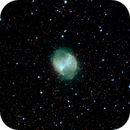
Dumbbell Nebula
The Dumbbell Nebula is a planetary nebula in the constellation Vulpecula, at a distance of about 1360 light-years.
*Dumbbell Nebula from Everett Quebral's AstroBin gallery*
*View on AstroBin: [https://app.astrobin.com/i/350995](https://app.astrobin.com/i/350995)*
About Dumbbell Nebula
The Dumbbell Nebula is a planetary nebula in the constellation Vulpecula, at a distance of about 1360 light-years. It was the first such nebula to be discovered, by Charles Messier in 1764. At its brightness of visual magnitude 7.5 and diameter of about 8 arcminutes, it is easily visible in binoculars and is a popular observing target in amateur telescopes.
Learn more on Wikipedia: https://en.wikipedia.org/wiki/Dumbbell_Nebula
What Creates the Appearance
The Dumbbell Nebula is a planetary nebula in the constellation Vulpecula, at a distance of about 1360 light-years. It was the first such nebula to be discovered, by Charles Messier in 1764. At its brightness of visual magnitude 7.5 and diameter of about 8 arcminutes, it is easily visible in binoculars and is a popular observing target in amateur telescopes.
The Science Behind the Beauty
The Dumbbell Nebula is a planetary nebula in the constellation Vulpecula, at a distance of about 1360 light-years. It was the first such nebula to be discovered, by Charles Messier in 1764. At its brightness of visual magnitude 7.5 and diameter of about 8 arcminutes, it is easily visible in binoculars and is a popular observing target in amateur telescopes.
Capturing the Target
Equipment and Setup
- Telescope: Refractor or reflector with suitable focal length for the field of view
- Camera: Dedicated astronomy camera or modified DSLR
- Filters: Narrowband (Ha/OIII/SII) for emission nebulae; broadband RGB/L for galaxies and reflection nebulae
- Mount: Solid equatorial mount with accurate tracking
- Guiding: Autoguiding recommended for longer exposures
Imaging Strategy
For narrowband, gather multiple long sub-exposures in Ha, OIII, and SII. For broadband, collect balanced RGB data with sufficient luminance for detail.
Processing Techniques
- Calibration: Apply darks, flats, and biases
- Registration & Integration: Align and stack frames
- Linear Processing: Gradient removal and color calibration
- Stretching: Gradual histogram stretches to reveal faint structure
- Detail Work: Noise reduction, deconvolution, and local contrast
The Surrounding Region
This target often sits within a rich region of gas, dust, and star-forming activity. Wide fields can capture multiple catalog objects, dark nebulae, and star clusters in the same frame.
Challenges and Rewards
- Faint Structure: Demands long total integration time
- Light Pollution: Narrowband can help under bright skies
- Weather & Seeing: Stable conditions improve small-scale detail
Tips for Success
- Plan sessions across multiple nights
- Balance exposure lengths for core and faint regions
- Use masks to protect stars and highlight nebular structure
- Keep a non-destructive workflow for iterative refinement
Conclusion
The Dumbbell Nebula is a planetary nebula in the constellation Vulpecula, at a distance of about 1360 light-years. It was the first such nebula to be discovered, by Charles Messier in 1764. At its brightness of visual magnitude 7.5 and diameter of about 8 arcminutes, it is easily visible in binoculars and is a popular observing target in amateur telescopes.
Technical Data
- Object: Dumbbell Nebula
- Type: Planetary Nebula
- Constellation: Vulpecula
- Distance: 1360 light-years
- Size: 1360 light-years
- Magnitude: 7.5