Observation Notes
The Crab Nebula
The Crab Nebula (M1, NGC 1952) is a supernova remnant in Taurus, the expanding debris of a recorded supernova in 1054 CE. Its filaments trace ionized gas while a central pulsar powers broad-band synchrotron emission…
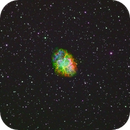
The Crab Nebula
Oct 11, 2018 · 151 views · 1477×1421 · 3.51 MB · 5h 34m
*The Crab Nebula from Everett Quebral's AstroBin gallery*
*View on AstroBin: [https://app.astrobin.com/i/371184](https://app.astrobin.com/i/371184)*
About M1 (Crab Nebula)
The Crab Nebula (M1, NGC 1952) is a supernova remnant in Taurus, the expanding debris of a recorded supernova in 1054 CE. Its filaments trace ionized gas while a central pulsar powers broad-band synchrotron emission that glows from radio to X-ray.
What Creates the Appearance
Delicate, reddish filaments trace ionized hydrogen and nitrogen from the ejected stellar material. The bluish core glow is synchrotron emission from relativistic particles accelerated by the Crab Pulsar’s powerful magnetic fields.
The Science Behind the Beauty
At the heart is PSR B0531+21, a rapidly rotating neutron star (~30 Hz). Its wind nebula energizes the remnant, producing non-thermal radiation while shock-heated filaments emit in Hα, [N II], and [O III]. The Crab is a benchmark for studying particle acceleration and magnetohydrodynamics.
Capturing the Target
Equipment and Setup
- Telescope/Optics: Medium focal length refractor or reflector for a tight field
- Imaging Camera: Dedicated astro camera
- Filters: LRGB for the synchrotron continuum; Hα/[O III] can enhance filaments
- Mount: Accurate equatorial mount
- Guiding: Autoguiding for long sub-exposures
Imaging Strategy
Collect deep L and RGB for the continuum and add Hα and [O III] to accentuate filaments. Shorter subs can help preserve the bright core while longer subs capture faint outer structure. Consider HDR techniques if needed.
Processing Techniques
- Calibration: Apply darks, flats, and biases
- Registration & Integration: Align and stack frames
- Linear Processing: Gradient removal and color calibration
- Stretching: Gradual histogram stretches to reveal faint structure
- Detail Work: Noise reduction, deconvolution, and local contrast
The Surrounding Region
This target often sits within a rich region of gas, dust, and star-forming activity. Wide fields can capture multiple catalog objects, dark nebulae, and star clusters in the same frame.
Challenges and Rewards
- Faint Structure: Demands long total integration time
- Light Pollution: Narrowband can help under bright skies
- Weather & Seeing: Stable conditions improve small-scale detail
Tips for Success
- Plan sessions across multiple nights
- Balance exposure lengths for core and faint regions
- Use masks to protect stars and highlight nebular structure
- Keep a non-destructive workflow for iterative refinement
Conclusion
M1 combines bright, non-thermal core glow with intricate emission filaments—an iconic target that rewards careful dynamic-range management and deep integration.
Technical Data
- Object: The Crab Nebula
- Type: Supernova remnant and pulsar wind nebula
- Constellation: Taurus
- Integration: 5h 34m
- Resolution: 1477×1421 px
- Filters used: LRGB with Hα/[O III] accents
Equipment
Imaging Equipment
- Optics: Medium focal-length refractor/reflector
- Camera: Dedicated astro camera
- Mount: Equatorial mount with guiding
- Filters: LRGB; Hα, [O III]